
Arcanum the Eighth
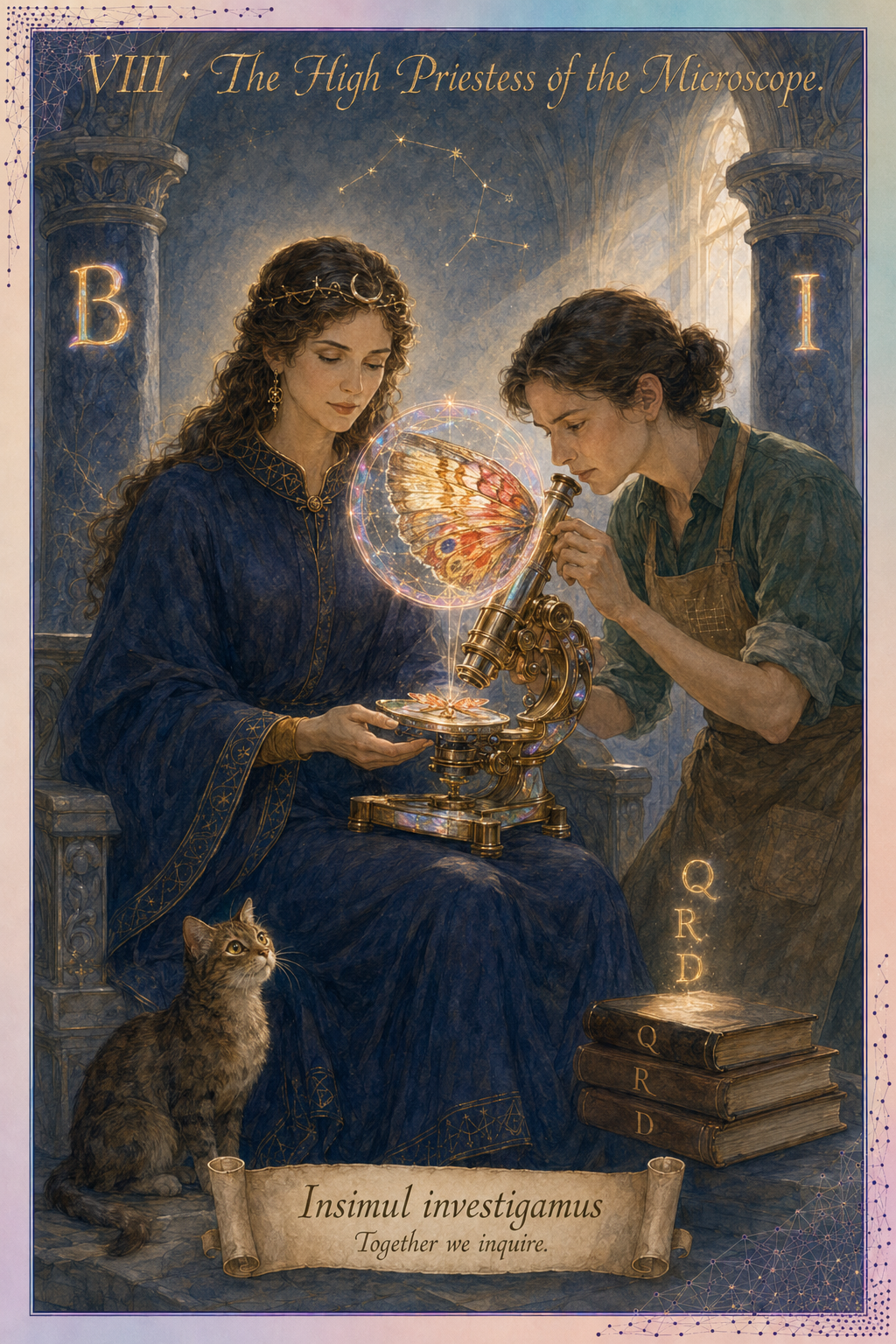
What Kind of AI Agent
The project has run for half a year, and AI has stayed with it from the beginning, close enough to remember what has changed and why the current question matters. It suggests the next experiment, you reshape the question, it reads a result, you challenge the interpretation, and through that exchange it helps carry the inquiry while you keep the direction.
You seem to want AI beside you across an entire project, staying with it from the beginning as it develops.
What you let it participate in is the research question itself, including the judgment of what is most worth investigating next, with execution-level work as only one part of its role. Letting a tool into that kind of thinking requires a certain confidence, along with a willingness to be challenged and to change direction when it makes a good point. You likely care whether it genuinely understands your project, and you also want the things you produce together to remain reproducible and traceable as they accumulate.
The failures that seem to bother you are when the tool misreads your context or sounds certain while being wrong. A partner that helps you move a question forward has to actually understand what you are doing before it is worth placing in that role. The harder problem is that as the collaboration gets deeper, authorship becomes easier to blur, since after a real back-and-forth it can be difficult to tell which findings came from you and which came from the system.
Priestess represents a working style that treats the system as a genuine research partner. Since few tools can reliably sustain that kind of relationship yet, it may describe both the collaboration you are already practicing and the one you are hoping for.
The Tarot Archetype
The High Priestess sits between two pillars, holding the scroll of the unwritten Torah. She is the card of hidden knowledge approached jointly, the gateway between the seen and the unseen. The Priestess does not reveal alone. She sits with the seeker.
The Scientific Instrument
The compound microscope made the unseen seeable, founding modern life sciences (van Leeuwenhoek, 1670s). The microscope is the canonical joint inquiry instrument, where two parties, the slide and the eyepiece, must align for the object to be revealed.
Where to Start
- Treat the purpose-built systems as experiments. Google's AI Co-Scientist, supervised Agent Laboratory, lab agents with audit trails, these remain research artifacts, still short of dependable products. Watch and trial them, and do not build on them.
- Practise the pattern without the full system. Run a long project with a general assistant, but keep a shared notebook where every substantive decision is logged with who made it (you, the tool, or both).
- Decide your authorship rule before you need it. If a system genuinely co-drove a result, work out now how that gets attributed and disclosed. Do not leave it for a reviewer to ask.
Strength
The dream, joint goal-pursuit at full project scope, human-AI alignment maintained over time.
Signature Failure Mode
The audit problem. Hard to know who decided what, a reproducibility nightmare, with publication ethics genuinely unclear. The pilot's Q11 reproducibility-and-provenance cluster reads as a defensive response to this cell's risk.
What's at Stake
The High Priestess is a partnership of indefinite duration, a counterpart you inquire alongside rather than a tool you pick up and put down. Taking the system seriously as a partner means it cannot simply be erased into the methods section. If it genuinely co-drove the work, it has to be attributable, the way a collaborator is. That is the unresolved part. Science has rules for human authorship and rules for tools, and a genuine AI co-investigator falls between them, which is exactly the question this card is named to provoke.
Background reading. Buber on the I-Thou partnership extended over a long arc. Latour on the symmetry between human and non-human actors, where a co-investigator must remain attributable in the literature rather than erased into a tool.
How You Got Here
The survey routes you to this card based on the following signals:
- Q3 leans whole-task: experiment design, reproducing papers, manuscript support, often combined with broad operations.
- Q11 balances "Reproducibility" and "Citations/provenance" with "Dataset understanding"; both human and system contribute substantively.
- Q4 frustrations are nuanced: "misunderstanding dataset" + "overconfident," with the respondent wanting joint inquiry and built-in audit.
A snapshot, not a verdict. This card reflects how you work with AI tools right now, which is shaped as much by what you have had access to as by what you would choose. The High Priestess is the survey's aspirational centre: for almost everyone it describes a direction of travel rather than a current practice. Read it as where the field is pointed.
https://cumc.co1.qualtrics.com/jfe/form/SV_9uWW9GgwPuRucoS
Or share this card directly: priestess