
Arcanum the First
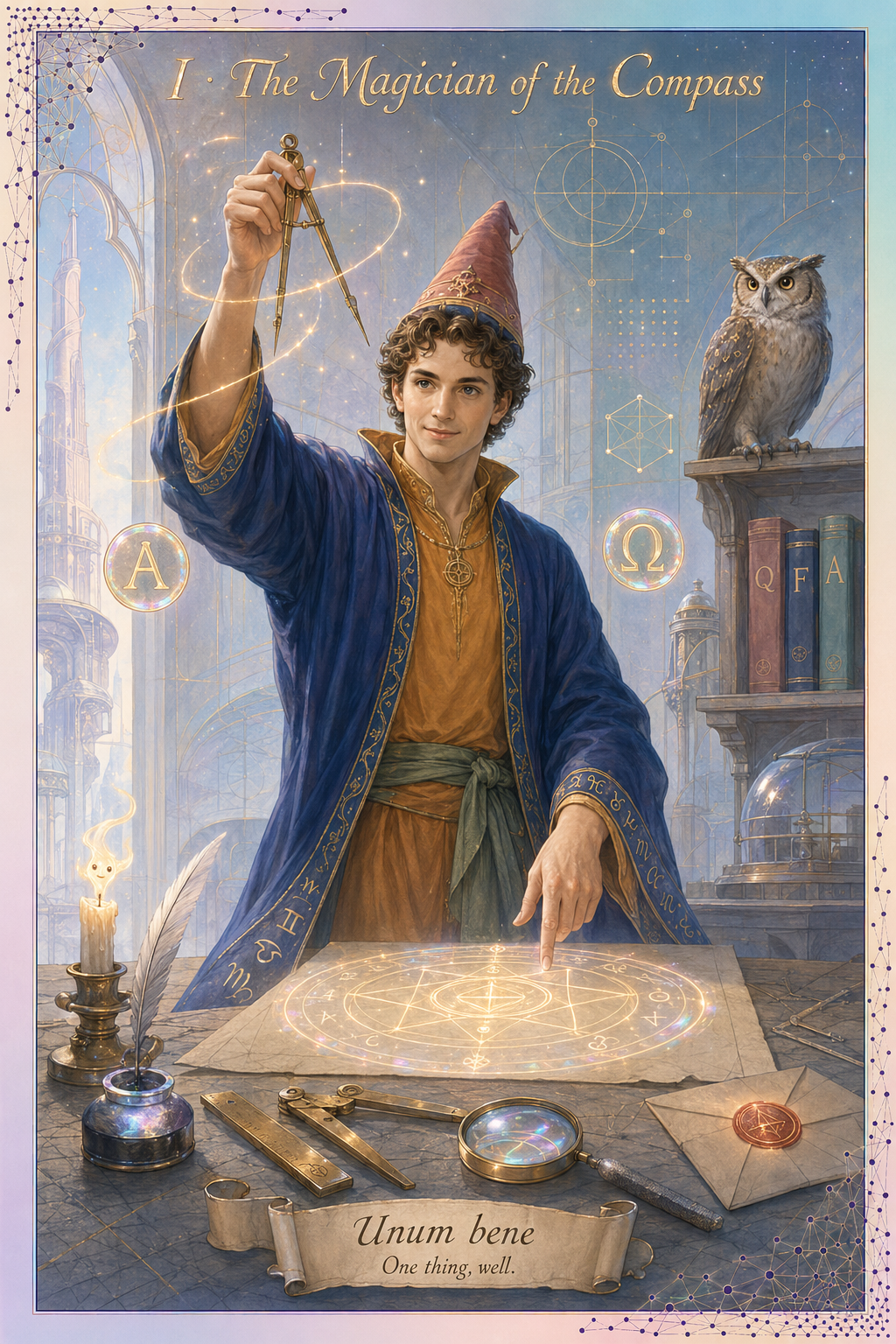
What Kind of AI Agent
You are mid-sentence in a function when the rest of the line appears in grey, exactly the completion you were about to type. You press Tab, and the work keeps moving.
You seem to use AI in small, clearly defined moves, each time calling it in for a specific task you have already chosen. The work you hand over is mostly mechanical overhead, such as completing a line or cleaning a stretch of data, while the real thinking stays with you. The initiative remains almost entirely in your hands, since you seem to prefer a tool that waits for your instruction rather than continuing on its own.
This habit does not read as simple caution. It seems to come from a clear sense of which parts of the work should stay with you and which parts are just friction. That kind of judgment usually comes from knowing your own workflow well. You likely value a tool that is fast, stable, and easy to verify, because a small action can be checked at a glance and undone quickly if it goes wrong.
The failures that seem to put you off are the ones that sound confident while being wrong. When the task is small enough, those errors are also easier for you to catch directly. The limit of this style is that it depends heavily on you already knowing what you want. When the task itself is still unclear to you, the tool has less to work with and can easily be pulled off course by an imprecise instruction.
Magician represents a working style that keeps AI within a short, deliberate range. Its value comes from the fact that you decide when to use it and exactly what to use it for.
The Tarot Archetype
The Magician channels intent through chosen tools. He stands between heaven and earth wielding the four suit-objects, the card of deliberate craft, a single intent, a single instrument, a clean act. Mastery here lies in choosing the right one for the moment rather than in knowing many tools.
The Scientific Instrument
The compass, a drafting and mathematical instrument used by Newton, Galileo, and every architect since Vitruvius. It establishes geometric precision through a single fixed point and an arc. The compass turns intent into measurable form, and only one form per setting.
Where to Start
- Lean on inline completion for the mechanical stretches. Boilerplate, repetitive edits, a format pass, the moves where you can verify the result by eye in a second.
- Keep a few one-shot prompts you trust. A citation-to-BibTeX converter, a regex explainer, a sentence-tightening pass. Reuse the ones that work rather than rebuilding them each time.
- Resist scope creep. The Magician's strength is the small surface. When you notice a tool quietly doing three things at once, treat that as a signal to step up to a broader card on purpose rather than by drift.
Strength
Trivially auditable. Predictable. The cleanest case for trust because the surface is small.
Signature Failure Mode
Brittleness. The Magician only works when you already know which tool to pick and how to wield it. Outside the operation's frame the instrument is silent, useless if you cannot name the spell, dangerous if you mis-name it.
What's at Stake
The Magician works because the tool disappears. When the move is well chosen, you stop noticing the tool at all. It becomes part of the reach of your hand, and your attention stays on the work itself. The risk is the mirror image of that strength. The moment you cannot name the move precisely, the tool is no help at all, and a mis-named move returns a confident wrong answer. The Magician's power and its limit are the same thing. It works only when you already know exactly what you want.
Background reading. Heidegger on the ready-to-hand tool that withdraws from awareness in skilled use (Being and Time, §15). Mollick on the centaur division of labour between human and machine (Co-Intelligence, 2024).
How You Got Here
The survey routes you to this card based on the following signals:
- Q3 (current uses) is dominated by narrow operations: coding/debugging, writing/editing, figures, data cleaning. Average scope score < 1.7.
- Q11 (top desired qualities) emphasizes "Human control / approval checkpoints" and "Clear explanation of uncertainty," pulling initiative toward the user.
- Q4 frustrations may include "overconfident answers" or "hallucinated citations," reinforcing the preference for user-initiated checks.
- Q1c expert/advanced competence pulls scope narrower and reinforces user-initiative.
A snapshot, not a verdict. This card reflects how you work with AI tools right now, which is shaped as much by what you have had access to as by what you would choose. The Magician is often where researchers begin rather than where they stay; as tools earn trust, many move toward broader scope. Read it as a current stance, not a fixed type.
https://cumc.co1.qualtrics.com/jfe/form/SV_9uWW9GgwPuRucoS
Or share this card directly: magician