
Arcanum the Fifth
What Kind of AI Agent
You seem used to working with AI on fairly broad pieces of work, moving back and forth as the task gradually takes shape. A typical process might be that it proposes an angle or drafts one part, then you keep what is useful, adjust what has drifted, and let it continue from there.
What seems to place you in Lovers is your willingness to let AI participate in the judgment process itself. You treat it as something to think with, and through the back-and-forth, your own reasoning becomes clearer. You seem comfortable letting it suggest where to go next, while still not wanting to gate every step yourself or leave it to run entirely unsupervised, so the direction of the task is maintained by both you and the system.
Because your collaboration with AI is quite close, what may bother you is that after a long conversation, it can become difficult to reconstruct who made which decision. That may explain why a clear process record matters to you, such as a visible edit history or a simple note on which parts came from where. This kind of record lets the collaboration stay legible when you look back later or when someone else reviews it.
Lovers represents a working style where the result is genuinely shaped by both sides. What protects that collaboration is your continued ability to distinguish which judgments came from you and which contributions came from the system.
The Tarot Archetype
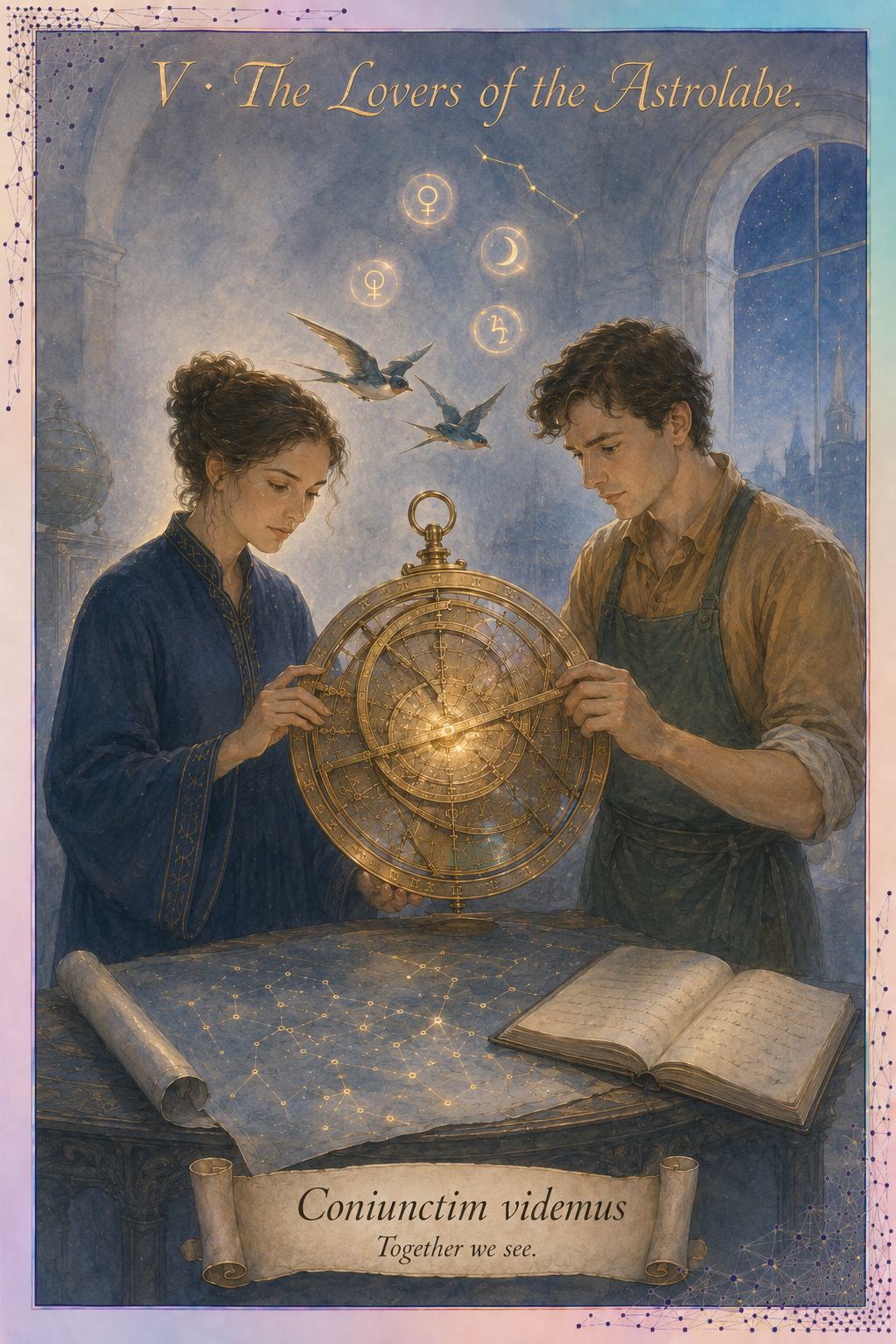
The Lovers card is canonically about aligned choice, two figures whose decisions stay in sync. The romantic reading is the surface, and the deeper reading is partnership in pursuit of a shared aim. The card is the cleanest Tarot image of collaboration.
The Scientific Instrument
The astrolabe, astronomical-navigational instrument used from the 8th to the 17th century. The astrolabe encodes the celestial sphere as a stack of nested rotating brass plates, and reading it is a joint act between the instrument and the reader's interpretation. Two hands easily turn the rete, while one alone is awkward.
Where to Start
- Work where the history is visible. A tool with checkpoints, a chat log, or a diff per step lets a long back-and-forth leave a trail you can walk back through.
- Close each session with a few lines. Note the decisions that mattered and who drove them. It costs a minute and saves the reproducibility headache later.
- Do not carry forward what you cannot account for. When a turn produces something you do not fully understand, stop and close that gap before continuing. Accumulated unexamined work is the Lovers' real risk.
Strength
The most defensible position for daily research work, where neither user nor system bears the full burden of correctness.
Signature Failure Mode
Ambiguity over who decided what. At the end of a long session you may not be able to reconstruct which choices were yours and which were the system's, a real reproducibility risk and a thin foundation for scientific authorship.
What's at Stake
The Lovers is genuine partnership. The system is a real contributor to the work and more than a tool you simply operate, and the result belongs to the pair. Treating the human and the system as equal members of one working network is part of what makes the collaboration productive. But science is judged from the outside, and an outside reviewer has to be able to see how a result was reached. The risk is muddled provenance, a finished phase that neither of you can fully break back into your decisions and its decisions, which is a thin foundation for authorship.
Background reading. Mollick's centaur pattern of human-AI collaboration (Co-Intelligence, 2024). Buber on the I-Thou partnership. Latour on the symmetry between human and non-human actors in a shared network (Reassembling the Social, 2005), with the proviso that the joint work stays legible to outside reviewers.
How You Got Here
The survey routes you to this card based on the following signals:
- Q3 mixes narrow and broad operations roughly equally, scope score 1.7–2.3.
- Q11 balances user-control and system-initiative qualities (e.g., "Citations/provenance" + "Code quality" without a strong pull either way).
- Q4 frustrations are present but moderate; the respondent accepts AI work and wants to refine it jointly rather than gate it.
A snapshot, not a verdict. This card reflects how you work with AI tools right now, which is shaped as much by what you have had access to as by what you would choose. A great deal of everyday research with AI already sits at the Lovers, but how the work is split between you and the system shifts from task to task. Read it as a snapshot.
https://cumc.co1.qualtrics.com/jfe/form/SV_9uWW9GgwPuRucoS
Or share this card directly: lovers